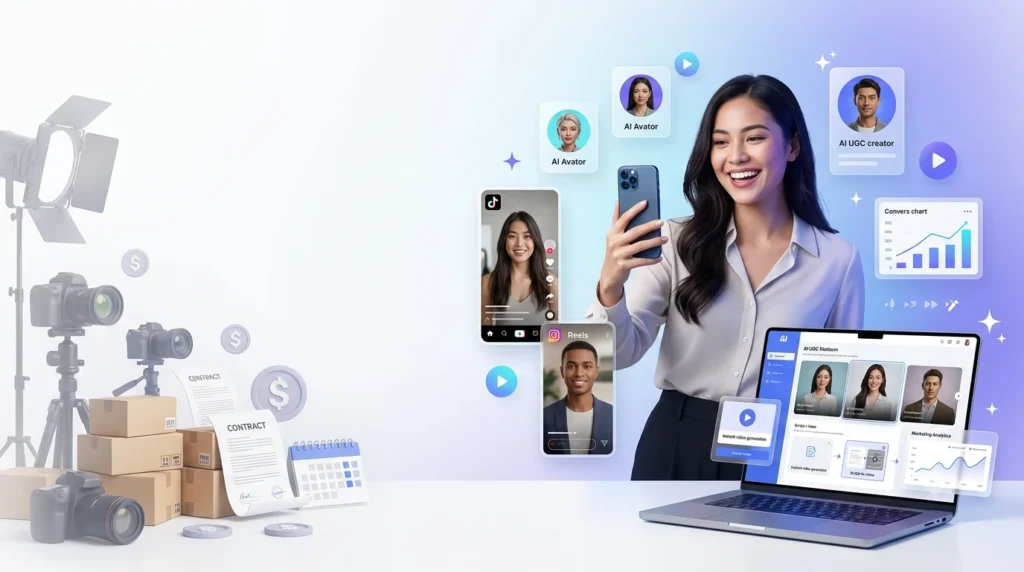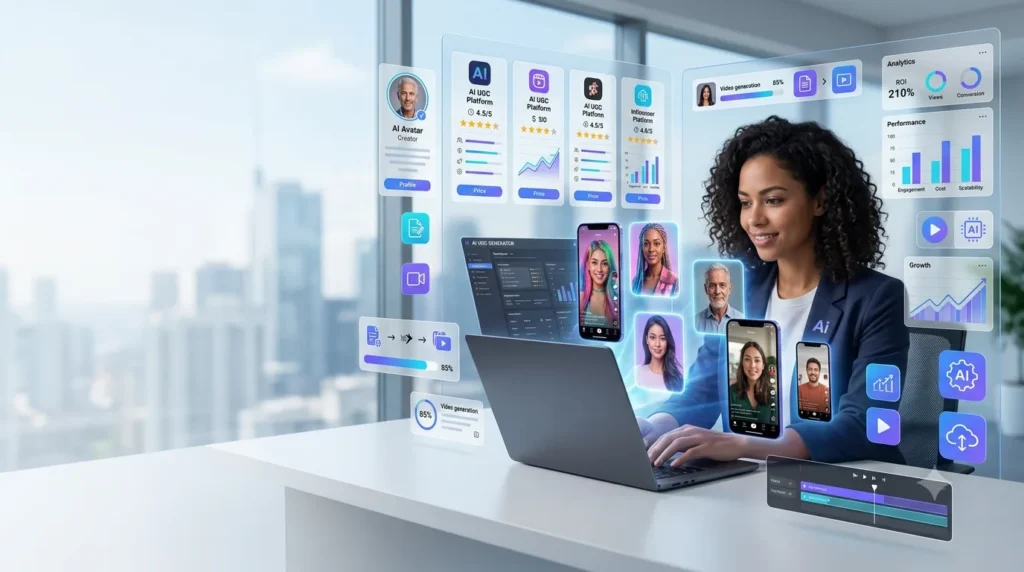
A few years ago, “UGC” meant reaching out to real creators, negotiating rates, shipping products, and waiting weeks for footage. In 2026, a growing number of e-commerce and DTC brands are skipping that entire process and generating their UGC ads with AI instead. This shift has a name — AI UGC — and one platform leading the charge is MakeUGC.
Here’s what AI UGC actually is, why brands are moving away from traditional production, and why so many marketing teams are switching to MakeUGC specifically.
What Is AI UGC?
AI UGC is short for AI-generated user-generated content — video ads that look and feel like authentic customer testimonials, but are produced entirely by artificial intelligence instead of a real creator. An AI avatar delivers your script on camera, mimicking the tone, pacing, and casual delivery style that makes traditional UGC so effective on Meta and TikTok.
The appeal is simple: brands get the performance benefits of authentic-feeling video without the cost, delays, and logistics of working with human creators.
Why Traditional UGC Production Is Breaking Down
Traditional UGC still works — but the production model behind it hasn’t kept pace with how fast performance marketers need to test creative. A few recurring pain points are pushing brands toward AI alternatives:
- Slow turnaround — briefing a creator, waiting on filming, and getting revisions back can take one to three weeks per video.
- Rising creator costs — as UGC demand has grown, so have creator rates, especially for niche products or multiple ad variations.
- Inconsistent quality — even experienced creators vary in delivery, pacing, and how closely they follow the brief.
- Limited testing volume — most teams can’t afford to commission ten different hooks from ten different creators just to find the winning angle.
- No easy localization — filming separate versions for each target language and market multiplies cost and time even further.
AI UGC tools solve each of these by moving production entirely in-house, on-demand, and at a fraction of the cost.
Why Brands Are Switching to MakeUGC Specifically
Not all AI UGC tools are equal, and this is where MakeUGC has pulled ahead for a lot of performance marketing teams.
1. Realistic, Diverse AI Avatars
MakeUGC offers a large library of AI avatars spanning different ages, ethnicities, tones, and delivery styles, making it easier to match an avatar to a specific target audience instead of settling for a generic, one-size-fits-all spokesperson.
2. Multiple Video Engines in One Dashboard
Instead of being locked into a single rendering style, MakeUGC gives users access to several different video generation engines, so teams can generate the same script multiple ways and pick whichever output performs best for their product.
3. Product-in-Hand Realism
One of the most requested features in AI UGC is an avatar that can naturally hold and interact with a physical product — and MakeUGC’s Product-in-Hand feature handles this convincingly, without the green-screen compositing older tools rely on.
4. Built-In Ad Analysis
MakeUGC’s Video Agent can analyze a reference ad (yours or a competitor’s) and help rebuild its structure — hook, pacing, and delivery — using your own product and script. This lets teams replicate proven ad formats instantly instead of starting from a blank page.
5. Speed and Cost
A finished video typically renders in just a few minutes, and pricing is structured around predictable monthly plans rather than per-creator fees — making it realistic to test far more ad variations for the same budget.
6. Multilingual, Global-Ready Output
With lip-synced avatar delivery across dozens of languages, brands can localize ad creative for new markets without booking a single additional creator.
AI UGC vs. Traditional UGC: A Quick Comparison
| Traditional UGC | AI UGC (MakeUGC) | |
|---|---|---|
| Turnaround time | Days to weeks | Minutes |
| Cost per video | High, scales with volume | Low, fixed monthly plans |
| Testing volume | Limited by budget/creators | High — test many angles fast |
| Consistency | Varies by creator | Consistent, scriptable |
| Localization | Requires new creators per market | Built-in multilingual avatars |
| Authenticity ceiling | Very high (real person) | High and improving fast |
Traditional UGC still has an edge in raw authenticity for hero campaigns, which is why many brands now use a hybrid approach — AI UGC for rapid testing, and real creators for scaling the winning angles.
Who’s Actually Switching?
The brands moving fastest to AI UGC tend to be:
- DTC e-commerce brands running constant Meta and TikTok ad tests
- Growth and performance marketing teams measured on creative testing velocity
- Agencies managing creative production across many client accounts at once
- Lean startups that need testimonial-style ads but don’t have budget for a full creator pipeline
Getting Started with MakeUGC
Switching to AI UGC doesn’t require a big commitment. Most teams start by:
- Creating an account at makeugc.ai
- Testing the low-cost trial plan on one or two existing scripts
- Comparing AI-generated output against their current best-performing creator ad
- Scaling up usage once they see the testing speed and cost savings firsthand
Final Thoughts
The shift toward AI UGC isn’t about replacing authenticity — it’s about removing the bottleneck that’s kept most brands from testing enough creative fast enough. As avatar realism keeps improving and features like Product-in-Hand close the remaining gaps, platforms like MakeUGC are becoming a core part of how performance marketing teams operate in 2026.
Curious how it performs on your own product? Head to makeugc.ai and generate your first AI UGC video to see the difference for yourself.
Frequently Asked Questions
What does AI UGC mean? AI UGC refers to user-generated-content-style video ads created entirely with artificial intelligence, using AI avatars instead of real creators.
Is AI UGC as effective as real UGC? Many brands find AI UGC performs comparably for testing and early-stage ad iterations, while still using real creators for scaled, hero campaigns. Results vary by product and script quality.
Why are brands switching to MakeUGC over other AI UGC tools? MakeUGC combines a large avatar library, multiple video engines, a Product-in-Hand feature, and fast, affordable rendering in one platform, making it a practical option for teams that need to test creative at volume.
How much does MakeUGC cost? MakeUGC offers monthly plans starting at a budget-friendly entry tier, along with a low-cost trial so you can test output quality before subscribing. Check makeugc.ai for current pricing.
Can I use MakeUGC for international ad campaigns? Yes — MakeUGC supports multilingual, lip-synced avatar delivery, making it suitable for localizing ad creative across different markets.